Agent Operator HQ: The Desktop Face Of Nature Work
In April we wrote about Nature Work: Claude Code and Codex on your own machine, driven from your phone while you walk. That still works. What we didn't cover is the other half of the day, at a desk with a big monitor and a dozen sessions open. That half is Agent Operator HQ.
One module, two names
Nature Work and Agent Operator HQ run the same sessions on the same machine. Only the screen they expect differs.
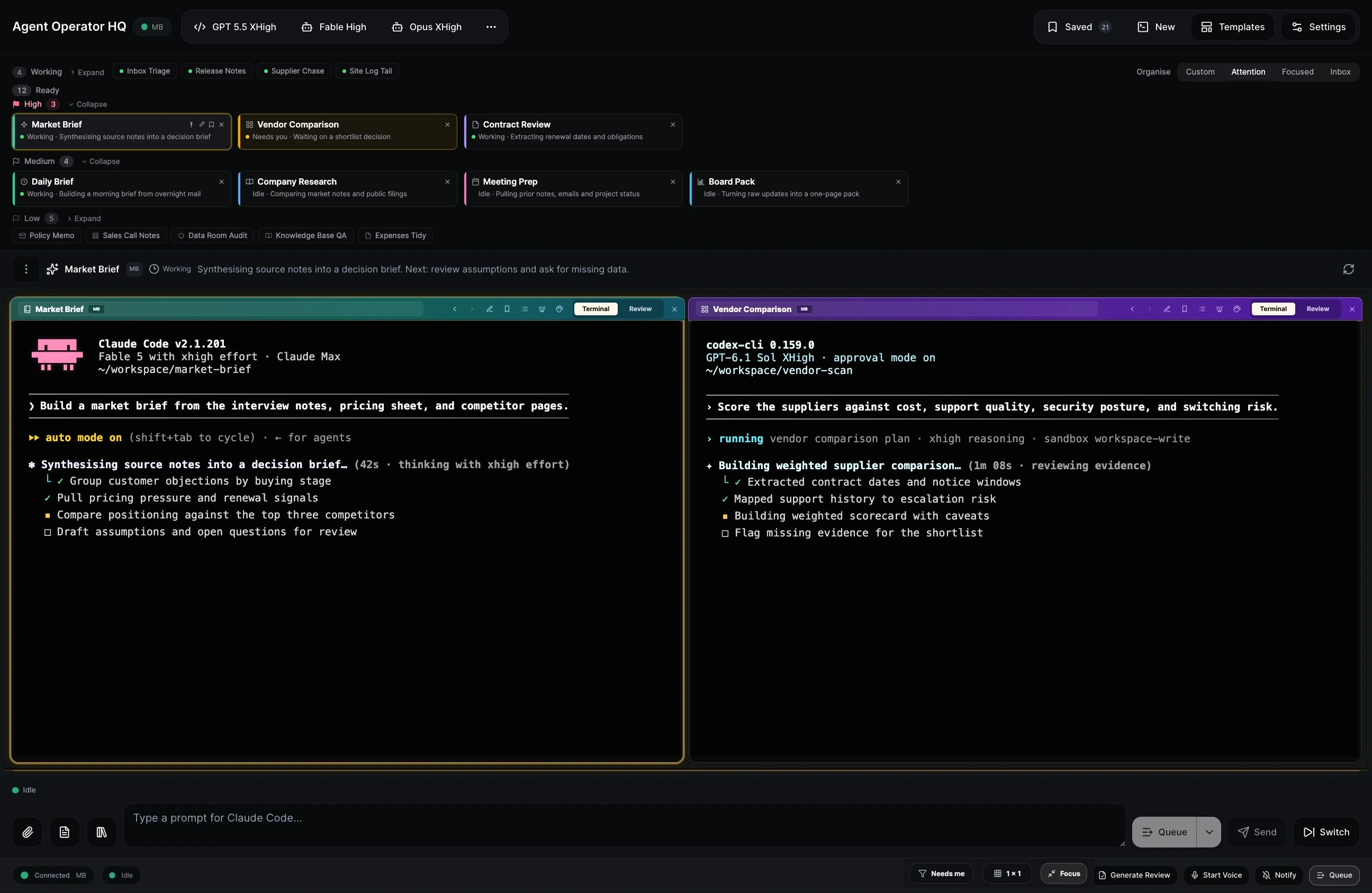
Agent Operator HQ is the desk view: a full-screen terminal grid, session cards along the top, keyboard shortcuts, and the prompt queue below.
Nature Work is the phone, tablet and AR glasses view: big touch targets, voice input, gamepad control, one terminal at a time.
Raq.com remembers which face you were on, and offers to move you if you open the desk view on a phone. Both names appear in the sidebar and Cmd+K, and agents on MCP find either.
What happens when there are fifteen of them
Nature Work was built when four agent sessions felt like a lot. We now run twelve or twenty. Past a certain number the only question is which one needs you next.
High, medium and low
Every session carries a priority you set: high, medium or low. It's your triage, not a guess from activity, and medium is the default, so untriaged work never looks urgent.
Sessions ready for you split into three bands. Drag a card between bands to change its priority, or within one to reorder.
Each band remembers whether you left it open or shut. High and Medium show full cards; Low and Working collapse to pills, so ten idle sessions take one row instead of ten.
Priority survives a session dying and restarting. Set it from the card's flag, any terminal pane toolbar, or the AI title dialog, where each suggestion carries High, Med and Low buttons.
Tabs also stopped reordering by recent use, because nothing was ever where you last saw it. Opening a session leaves it put, new ones lead, and pinned stay first.
Four ways to organise
The Organise control above the session list has four options.
Custom is your own order. Drag sessions where you want them.
Attention groups by what each session is doing: Ready, Working, Background, and Ended or Offline. Ready holds the priority bands.
Focused shows one terminal and nothing else: no tabs, a one-sentence status, a Next button. While it's selected, Raq.com checks your sessions each minute and classifies each as needing you, blocked, apparently finished, or safe to close. Only those appear, so when nothing needs you the workspace stays empty.
Inbox turns the session list into a left sidebar of cards, each with a status chip, the session's summary, and one obvious action: Reply if it's waiting on a decision, View Review if a report is ready, Restart if it died, Open otherwise. Anything waiting on you also gets Defer 1h. It reads like an email inbox. It needs the width, so a phone falls back to Attention.
Cursor
Cursor CLI now runs alongside Claude Code and Codex, with the same prompt queue, reviews, titles and status detection. Each CLI signals differently, so each is separate work: Cursor leaves the last submitted prompt in its composer after finishing, and its first-run trust dialog uses letter hotkeys, not a numbered menu. Both needed handling before the queue could drain unattended.
Everything else since April
- The terminal grid holds up to nine sessions, three by three, with layout presets. Each tile takes its own input.
- Every session keeps a rolling summary of what it's working on, shown on its card and above the terminal.
- Sessions can be linked, at creation or after. Linked ones sit together, share an outline, and open as a group.
- The moon toggle parks always-on sessions, an Orchestrator or log tail, in a Background lane. Idle notices leave them alone; a blocking prompt or finished review still pulls them out, and a dead one appears under Ended.
- Drag a file onto the terminal or paste an image straight in, up to 100 MB.
- Snooze a session for a set time, until it next changes, or until a date you pick.
- A half-typed prompt is kept and its tab marked, so the one you walked away from is easy to find.
- Schedule a prompt for later, reorder the queue, copy or send now, and see the queued count on each tile.
- Ask any session for a written report with screenshots. New ones open on their own when ready.
- Templates store which agent a session runs, its start command and its opening prompts. Mark the ones you use daily and they become one-click launches in the header. There's a prompt library picker in the composer too.
- AI titles can be overridden by hand, and you can set your own instructions for how titles and summaries read. Tabs take an emoji or icon, a colour, and a custom agent name.
- The full scrollback opens in one dialog, alongside a record of the prompts you've already sent that session.
- There's a system notification toggle, and per-session reminders for a nudge about one session rather than all.
- Saved tabs, pinned tabs, an undo window after closing one, and a Hide Tabs control that gives height back to the terminal.
- Cmd+. jumps to the next session that needs you.
- Dead sessions stay on the bar with a Restart button instead of vanishing. Stale Working labels heal themselves. Anything that finished while you were offline replays when you reconnect.
Getting started
Both faces are one module and one toggle. Turn on Nature Work, run the one-line install on the machine your agents live on, and your sessions appear in the browser within a minute. Open Agent Operator HQ at your desk or Nature Work on your phone. Same list either way.
Agent Operator HQ and Nature Work are included with every plan. Start your free trial. No credit card required.